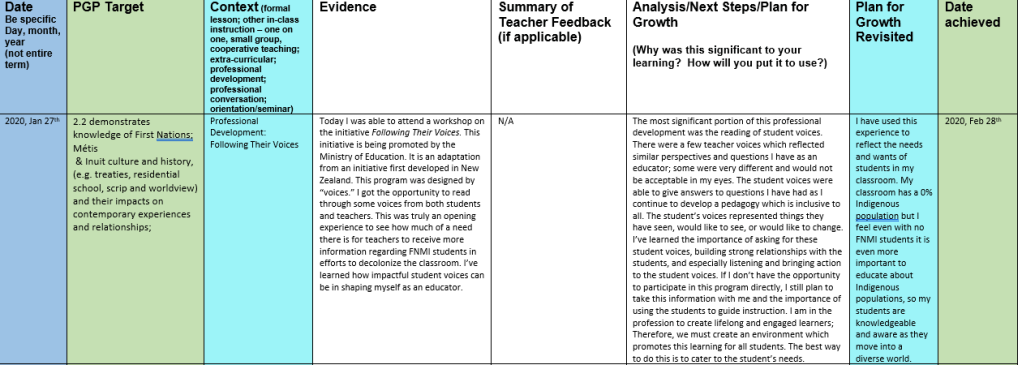
PGP Sample
This may not be my first year in Education, but it has been a year of many firsts. This was my first time getting to teach in a city school, my first time engaging in sanctions, my first time taking on-line classes, my first time letting my grades go, my first time teaching a classroom on my own.
My year has been eventful to say the least and it is a year to reflect on. This year I had my first placement in a city school. This was a west-end school which allowed me to not only encounter racial diversity in the classroom but also a socio-economic diversity. Growing up in a rural school I did not experience either of these, we were mostly all white middle class students. Being in the school was a great learning opportunity to reflect on my culturally responsive teaching, my FNMI incorporation in my class, and to see some of the less than appealing aspects of teaching. I learned more strategies to foster an inclusive environment, to deal with conflict, and how to handle students with exceptionalities. Through this placement I was not only able to build my pedagogy but also my understanding of the legal concepts of schooling, something I have not encountered explicitly yet. This includes the sanctions I experienced in my second term. I was surprised the impact this caused. One day I was helping coach our school badminton team, and the next day the students went to their first and last badminton game. It was then the next week I had to make adjustments to my preparation; I was no longer able to get to school so early to speak with my teacher about what I would teach that day.
Next came the pandemic which shut down schools. I was heart broken to have to leave my placement so early though it is what had to happen. Though I am happy to not be a teacher at this time because the adjustment to solely using technology is difficult, especially for our early years teachers. Much of my teaching philosophy does not translate to a zoom classroom but it has shown me how flexible one needs to be as a teacher.
This year I have also been working to make a mental shift; to stop worrying about my grades as much and to focus on my actual learnings and reflecting on those. Unfortunately, I am still working towards this but I have seen how the practical aspect matters much more than the number on my transcript. Lastly, I got my first position as a substitute teacher (in Manitoba). This has enabled me to utilize everything I am learning in University and the College of Education and putting it into practice. My first day in a classroom was difficult, not knowing a single students name is horrible, walking in to teach lessons that you did not plan is intimidating, and classroom management was a struggle to begin with. Luckily, I am able to take these opportunities and continue learning from them.
As an early years teacher the most important aspect of my teaching philosophy is relationships. I believe relationships are the central point to becoming an effective teacher. If a teacher does not have positive relationships with students, students are going to be more reluctant to learn in their class. An important aspect to building relationships is the classroom environment, the physically and emotional. My ideal environment is one which allows students to learn collaboratively, in table groups, with lots of room around the class to move around. I encourage lots of discussions in my class and my seating often reflects that. I also hope to keep my class culturally responsive, where students can embrace their backgrounds and see a piece of them in the classroom. Whether that be through books, posters, flags, language, etc.
I believe students should learn by doing. I strive to deliver a holistic method of learning to my students to engage them physically, mentally, emotionally, and spiritually. The learn by doing strategy allows students to interpret themselves as individuals and learn by their own physical actions. The learn by doing method often prompts mostly formative assessment which I find ideal as I am mostly against standardized testing. I still struggle with maintaining this as I am aware of the need for evidence, and am looking for new strategies to provide adequate evidence of formative assessment. Fortunately, our digital world helps achieve this. My teaching will reflect technology in a positive manner and it will be used to supplement learning in the class.
The method of instruction is also extremely important to my philosophy. I hope to incorporate several different teaching strategies in my teaching. Some of my favourite strategies are think-pair-shares, chalk talk, see-think-wonder, question sorts, I used to think.. but now I think, inner circle-outer circle, and U-shaped spectrum. The topic will depend on the method of instruction but through all of these students are central of the learning. These strategies emphasize collaborative learning and help build students engagement and desire to learn. With my teaching philosophy focusing on collaborative learning, and holistic instruction classroom management becomes more difficult. Luckily, my extrovert self enjoys the cheesy early years strategies to maintain sanity in the class (Mac and Cheese, everybody freeze!). As well this is where the relationships come in and if students know that you trust them enough to allow them to lead their own learning in such a strong manner, you hope you receive that respect back.
Assessment is a vital aspect to teaching. It is the way to prove or disprove whether a student is meeting curricular outcomes and indicators. There are 3 types of assessment: for, as, and of.
Assessment for learning is essentially the pre-learning, finding out what students already know about a topic. This assessment can be formative or summative and should guide the teacher’s instruction for the lesson/unit. I have encountered this in this ECUR 165, during week 3 you asked us what the difference between a high school and a collegiate, or a comprehensive school. If we had all known the answer to this question, it would not be worth teaching about. Though through asking one question it was seen that next to none of us knew what the difference was, making it important to explicitly teach.
Assessment as learning is done throughout instruction to make sure students are achieving desired results and are on track to meet the outcome of the lesson. This was also completed in ECUR 165 when we did our first jigsaw in week 4. The initial teaching of what a jigsaw had been done and we were sent off into our groups to begin the readings and summarizing. Through formative assessment as we were learning you seen that there was some uncertainty on how jigsaws were completed and to what extent summarizing needed to be done. Assessment as learning tells an instructor that students are either or the right track, or a catch and release may be needed (stopping students, rewording or clarifying instruction and then letting students continue working). This was done during this jigsaw by explaining the 2 types of jigsaws and which we would be completing, letting students know they would need to have a succinct summary of the article that gives those who have not read the article enough information to understand the premise and that each student would be required to share this.
Assessment for learning is done after teaching of a topic is completed; it shows whether or not students achieved the desired results. This is the assessment I am currently completing for this class. A website to summarize my learning throughout the course using prompts given by the instructor. This will tell the instructor if most students achieved the desired results and outcomes of the course. In this case the assessment is summative but may also be formative.
A KWL can be an easy way to incorporate all forms of assessment. KWL stands for know, wonder, and learned. When you are achieving know, you are finding out what the students already know about a subject (assessment for learning). When you are finding out what students are wondering about the topic you can guide your instruction and find out if they are leaning their interests towards a particular outcome or result (assessment as learning). When you reach the learned stage, you are doing assessment of learning to see if the students have achieved the desired outcome.
Differentiated instruction is extremely important for students as students have very unique qualities and learn different ways. As a teacher you want your instruction to reach each student the same, though we know that doesn’t happen and isn’t practical. One of the most important factors in differentiating is student interest. This is where relationships are so important so you get to know your students interests and can adapt instruction to meet those interests. If students are interested in a topic they are more likely to participate and succeed in it. If it were a grade 10 English class and a student was reluctant to write an essay, though this student enjoys technology and video games, I would allow this student to create a digital essay that may look like a video game, but would tell a story through the characters.
I believe that the method of instruction and assessment are also very important areas to differentiate. The method of instruction can be differentiated through utilizing multiple teaching strategies, trying new methods, and incorporating several technologies. If students are consistently expected to sit in a desk and work alone on assignment after assignment they are not as likely to succeed as when they participate in group work, think-pair-shares, chalk talk, tug of war, or many others. This teaching strategies also give the opportunity for differentiated assessment. Many of these do not include summative assessment though assessment is still achieved and students may not even realize it. Students will be more engaged and you are meeting a larger spectrum of student needs.
According to the VARK test I am a multimodial learner (visual and kinesthetic). I believe this is very true based on my personal reflections of how I enjoy learning. I believe this due to the fact when I am stuck on an exam or test, I will use my pencil to draw out in the air what I am thinking of when I can’t quite write it out. I know I am not auditory due to the fact I have had a show playing in the background while writing this but I have been able to effectively mute out the entire thing and not remember anything that is going on. These traits impact the way I teach and I have to be aware of my personal bias towards auditory learning and be sure to still include it when choosing method of instructional delivery. According to the MBTI test I am ESFJ. Which I can too believe though each category was very close to the 50% mark. It depends on my day to which way I go, as well as what I am doing. I believe being so flexible in these traits impacts my teaching positively allowing me to easily adapt to different situations and relate to students on a more personal level. I can relate to those students who are introverts because I grew up being a selective mute, as well I can relate to the extroverts as some days I will talk your ear off. This also allows me to feel comfortable trying new things and differentiating instruction, giving students a greater opportunity to learn in a way that best suits them. The students I may miss are those with exceptionalities that defer learning. This is due to my judging personality, though it was close, I believe myself that I judge more than I perceive. I often find myself having to stop and think “what if I were in their shoes.” This allows me to be more present in the situation and to be sure I am adequately including them in the instruction.
According to the TPI I am most strongly a nurturing and developmental teacher. As an elementary teacher I strongly believe this. Building a strong relationship with each student before I begin explicit teaching is important to me. I want each student to feel welcome in the class because if they don’t they are less likely to learn, or worse, attend class. My other strongest attribute is action, which I too believe.
| “If they can’t learn the way we teach, we teach the way they learn” -Dr. O. Ivar. Lovaas |
We as a group came up with this question when we were talking in class and comparing our personalities. I am really happy that my peer brought up this question because it is so important that we apply our learning to our future teaching. My answer to this question is it’s about the bigger picture. It is not about memorizing what letters each student is based on an online test, but about acknowledging the diversity in the class and planning your instruction to accommodate that. Knowing your students is still very important and if you do know more about your students you may have rationale for their actions and be able to for-see and take action. This sounds like an easy thing to do, but putting it into practice will be difficult.
As teacher’s we must acknowledge that each of our students have strength and weaknesses and I believe it is important to give opportunity for each of your students strengths to flourish. With the larger class sizes today than ever it is easier said than done. In doing this teachers need to maintain culturally responsive teaching and fostering a welcoming environment. I love inquiry based learning and I feel it is a great opportunity to allow for differentiated instruction while not feeling to stressed or overwhelmed in creating the instruction that fits each of your students unique needs and personalities. Students often know their own strengths and weaknesses and inquiry allows them to make the decisions to show their strengths. Other methods of differentiated instruction should include utilizing different teaching strategies, collaborative learning opportunities, co-creating, and different assessment strategies ( formative and summative).
This week was a week of learning a lot of new things. The biggest being the learnings around modified curricula. I learned modified curriculum in only available in grades 10-12 and must be approved through ministry. It is not an easy process and requires a discussion between ministry, school, parents, and student. As well as I learned that curricula can be modified up or down.
It was this week I also learned SK works on k-9 and grade 10 is the big change to high school and grades, for me it was grade 9 which was the large leap in curricula and content. This was a big realization for me that I need to dive deeper into the curricula for the future.
I compared the grade 10 Science curriculum’s of Saskatchewan and Manitoba. I found Manitoba’s curriculum hard to find in the beginning, and once I did find it, it was split into multiple PDF’s that I had to download individually to read through. The overall documents were not as in depth or visually appealing though they did contain more diagrams and tables. The site was much more difficult to navigate in comparison to Saskatchewan. I could not find any broad areas of learning or cross curricular learnings similar to that of Saskatchewan. These results may be altered due to myself navigating and used to Saskatchewan’s site in comparison to Manitoba’s. Additionally, Manitoba’s grade 10 science curriculum comes last updated in 2003, as compared to Saskatchewan’s updated curriculum in 2016.
| Saskatchewan | Manitoba | |
| Accessibility | Easy to navigate on Saskatchewan curriculum site. Has one PDF document composed of all material. A lengthy document. | Is embedded within an entire education site. Was difficult to find and the document is split into different pdf’s which can’t be opened all together. |
| Layout | Incorporation of words and visuals. | Lots of visuals. |
| Framework | Bal’s, CCC’c, aims and goals, scientific framework. | Scientific framework. |
| Curricular Content | Specific learning outcomes and indicators. | General and Specific learning outcomes. |
| Resources | Resources found on the same page, multiple resources. | Resources available on a separate page. |
Understanding by Design Long Range Planning Template (not formatted in this document properly)
Kindergarten
(See Appendix 1 for Principles of Early Learning.)
| Title of program design, project, inquiry, or ECD domain | Getting to Know Each Other | Time Frame | 4 weeks (8, 25 minute periods) |
| Developed By | Kaylin Hall | ||
| Stage 1 – Identify Desired Results | |||
| Broad Areas of Learning (See Appendix 2 for Broad Areas of Learning.) How will the Broad Areas of Learning be incorporated? | |||
| Students will gain a sense of self, community, and place by becoming more knowledgeable about those around them. With students learning about those in their class and community they will become more engaged and aware citizens. The differences and similarities students will encounter will help students prepare for a future of lifelong learning. Additionally, students will become practice reflecting and talking about their learning to help prepare them for lifelong learning. | |||
| Cross curricular Competencies (See Appendix 3 for Cross Curricular Competencies.) How will the Cross Curricular Competencies be promoted? | |||
| Students will develop thinking through engaging with multiple forms of literature, rich conversation and play-based exploration. The play will help students develop interdependence, while the unit focus on similarities and differences allows students to develop their own identity. Students will develop literacies by engaging with different mediums and forms of literature. Lastly, students will develop social responsibility by understanding the diversity that is seen in the class, community, and world around them. | |||
| Learning Outcomes What relevant goals will this timeframe, program design, project, or inquiry address? (This could come from curriculum [include the designations e.g. IN2] and/or from ECD domains [for example, fine motor, gross motor, language acquisition, etc.]) Before determining the big idea or ECD domain, observe the children multiple times, listen to their interactions, have conversations with their parents, and reflect by asking yourself these questions: What are my observations? What am I hearing from the children and their parents?What do I know about each child and what more can I learn about them through this timeframe, project, or inquiry? What questions are children asking? What have I learned about each child with respect to the four dimensions that will also inform my planning (see Questions to Guide Observations on pages 24-27 of Children First)? What are the needs of each child that might require further supports or adaptations? | |||
| INK.1 Demonstrate an understanding of similarities and differences among individuals in the classroom. CRK.4 Comprehend, retell, and respond to basic ideas in stories, poems, songs, and informational texts read to them. CCK.2 Use and construct symbols, pictures, and dramatizations to communicate feelings and ideas in a variety of ways. ARK.2 Reflect and talk about new learning. | |||
| Enduring Understandings What understandings about the big ideas are desired? (What do you want children to understand & be able to use several years from now?) What misunderstandings are predictable? | Essential Questions What provocative questions will foster curiosity and wonder into the content?(These are open-ended questions that stimulate thought, inquiry, and language learning linked to the content of the enduring understanding.) | ||
| Students will understand that… People around them whether in their family, classroom, community, or the world, have differences. I want students to acknowledge that these differences are okay and should be celebrated. As well students should know that amongst these differences in people are similarities between themselves and those around them. Related misconceptions… People with differences should be avoided. People who look a certain way are dominant. Students needing to follow the trends in their classmates may have or needing to change to “fit in” in the classroom. | Content specific…. Are all people the same? What do you notice about your peers in the class? What is the same, what is different? FNMI, multicultural, cross-curricular… Incorporating the differences and similarities of FNMI to others. Also comparing across different FNMI cultures whether be Cree and Dakota, or a broad First Nation and Metis or Inuit. This will be cross curricular with English so we will use the information found in different forms of literature to help us learn and accept differences of FNMI culture and traditions. | ||
| Knowledge and Vocabulary Acquisition: What knowledge and vocabulary will children acquire as a result of this timeframe, project, or inquiry? This content knowledge and vocabulary may come from the indicators (nouns) and/or ECD domains. | Skills What skills will children acquire as a result of this timeframe, project, or inquiry? List the skills and/or behaviours that children will be able to exhibit as a result of the experience. These will come from the indicators (verbs) and/or from ECD domains. | ||
| Children will know… The meaning of the term difference and similarity. How to retell the basic idea in a story, poem, or song. How to build symbols, pictures, and dramatizations to represent themselves. How to retell, reflect and talk about what they are learning. Types of different cultures seen in our classroom/community. The meaning of diversity. | Children will be able to… Give examples of differences and similarities that students have with others. Be able to comprehend basic messages from pictures, books, music, and videos. Participate in class discussions, listening and sharing with others. Show good listening skills through eye contact, body language, only talking when asked. |
| Stage 2 – Assessment Evidence | ||
| Anticipated Performance Task – We will create a classroom diversity book. Each student will get to create 1 page individually in our classroom book which represent them. This representation will be through a drawing and will be entirely up to each student to create based on their own idea of themselves. | ||
| GRASPS Elements of the Performance Task | ||
| G – Goal Students will create a representation of themselves as a part of a classroom book. | Rubric: Did you include… J K L Your Name? A drawing of yourself? Your family? Something you like to do? Something you like to play with? Your favourite animal? Words? Students do not have to share if they don’t wish too, but this will be done at the end of the unit in hopes students are comfortable embracing themselves. | |
| R – Role Students will get the opportunity to make 1 page that represents them. The final page of the book will be a page we co create, showing that we are all similar because we are in all in the classroom, with a picture of our class. Students get to draw these representations, though words underneath will be encouraged. | ||
| A – Audience The audience will be the students in the class, with the goal to create a more inclusive environment that accepts and encourages everyone’s similarities and differences and prepares students for a diverse world. | ||
| S – Situation The challenge students will face is to think of what information they want to share about themselves and how to represent it in an image, while also trying to add words to the page just as many books have. | ||
| P – Product, Performance The product will be the class book. I would title it “All About Us.” Students will be encouraged to use different mediums to create their images (crayons, markers, paint, tissue paper, stickers, foam, cut outs, etc). Students will get to present this to the class and explain their pictures. It will be kept in the class library and be available to take home. | ||
| S – Standards & Criteria for Success Students will complete the following rubric by putting the face they feel represents their work. | ||
| Other Evidence Through what other evidence (work samples, observations, scripted conversations, journals, or other means) will children demonstrate the achievement of the desired results or have their achievement captured? What are the considerations for being inclusive of all learning contexts: home, community, culture, school? | Documentation and Children’s Self-Assessment How will children reflect upon or self-assess their learning? How will evidence be gathered and shared to assist children in becoming aware of their thinking and to make their learning visible? How will this be shared with parents, and perhaps the community? | |
| Students will be formally assessed throughout each class and discussion. I will take notes during conversations to keep on record. Students will be encouraged to find and embrace the differences through the entire day and share their findings through daily sharing circles. Students will get the opportunity each week to share what they find in the invitation or something that they have learned from that week. | I will keep a record of comments and answers that children share at the beginning of the unit regarding similarities and differences. At the end of the unit I will ask the question again and share the students first answers with them. Our class book will be available for students to take home and discuss with their parents if they wish. Before starting the unit, I will make parents aware of the unit and allow for open communication of any concerns. The units focus is to not judge others and accept their differences so anything other than that will not be acceptable in the class. | |
| Stage 3 – Long Range Plans for the Learning Program, Project, Inquiry, or ECD Domain What teaching and learning experiences will you use to: achieve the desired results identified in Stage 1? equip children to explore the assessment tasks identified in Stage 2? | |
| Where are the children headed? Where have they been? How will you make sure the children know where they are going? What experiences do the learners bring to the planning? How have the interests of the learners been ascertained? Have the learners been part of the pre-planning in any way? | |
| Children are headed to creating a more inclusive classroom in a diverse environment. Students experiences in the past with diversity will differ but they will all have experience, but they may not have noticed it. I will make children and parents aware of the essential question “Are all people the same?” This unit relies on students and their experiences to inquire about their similarities and differences. The parents will be apart of the pre-planning and made aware of the unit plan and desired results. The content of the unit will vary depending on the students. | |
| How will you engage with parents to learn about the children’s interests, experiences, and knowledge building opportunities in home, cultural, and community contexts? How will you consider parents’ hopes and dreams for their children? Have parents been part of the pre-planning in any way? What invitational opportunities are there for parents to participate in the experiences? | |
| I will have a medium such as see-saw or fresh grade to create a platform for open communication between the parents and myself. I plan on doing home visits with each student to get to know each student and hopefully gain family trust. Parents will be greatly involved in pre-planning and any concerns will be taken into consideration. I will also send home a questionnaire for the students to complete with their parents/caregivers before starting the unit, as well as a letter indicating the unit plans for parents to comment on and revise. Parents will be asked if they wish to volunteer to talk about their culture with their child to the rest of the class. I will also seek information regarding cultures and traditions specific to each family from the parents. | |
| How will you provoke children’s curiosity and sense of wonder to introduce this timeframe, project, or inquiry? (Consider whether this will be an invitation, a group experience, the reading of children’s literature, an outdoor adventure, a small combination of planned experiences, and so on.) | |
| I will begin the unit with a puppet show. I will create sock puppets that are all the exact same and use them to read the story What if we were all the same! By C.M. Harris. While we read through the story students will be allowed to make changes to the sock puppets to make them different. By the end of the story all of the sock puppets should be different. | |
| What are open-ended stems and questions you might use to engage the children in conversation and/or thinking? (What would happen if . . . Tell me about . . . I wonder . . . How did you make that choice . . .) | |
| Are all people the same? What would happen if we were all the same? What is something that is different about you? What is something that is the same with you and others? What do you know about differences? | |
| What resources will you be using? (Include FNMI resources.Consider materials, print, media, technology, people, and so on. What are ways families and community can participate in supporting the children’s learning?) | |
| I will be using books (including FNMI stories), songs, pictures (including FNMI), sock puppets, classmates, foods, art, clothing pieces, toys, and games. | |
| What events will help children experience and explore the enduring understandings and essential questions in this timeframe, project, or inquiry? What experiences will equip them with needed skills and knowledge? | |
| Possibilities of Play Based Experiences What materials/resources are already available for the children related to their interests, and the curricular outcomes and ECD domains? What can I add to the environment to support children’s investigations through play and further develop their thinking? Considering the gifts, learning needs, and diversities of all children and families, what are the needs of each child that might require further supports or adaptations? | Possibilities of Educator Guided Experiences What materials/resources can I use that will provoke children’s sense of wonder and curiosity? How can I use a full or small group time to inspire further interest in the interest area? Considering the gifts, learning needs, and diversities of all children and families, what are the needs of each child that might require further supports or adaptations? |
| Observations and responding to children’s interests through focus-specific invitations (or provocations): Plan for location, materials, literacy support, and intended length of time. Plan for one or several invitational (or provocation) opportunities. Students interactions with one another and the diversity in our own classroom will help guide their knowledge. Invitation (focusing on culture): will be set up before each class at the beginning of the week, the invitation will change at the end of the week in preparation for the next week. Week 1: Books with several different languages representing students in the classroom. Week 2: Foods from different cultures of students in the class* Week 3: Art/clothing pieces specific to the cultures* Week 4: Games from different cultures* *All articles gathered and used will be in consultation with experts from those cultures and used in culturally responsive ways. | Observations and responding to children’s interests through whole class opportunities: Include the provocative text* you intend to use. Plan for one or several experiences and/or opportunities. *provocative text includes oral stories, children’s literature, songs, fingerplays, photos, artifacts, demonstrations, videos, conversations, etc. Before I begin this unit, I will take time to learn the students. I plan to do a home visit and get a better idea of the student’s culture, language, family structure, exceptionalities, and other interests. Students will be invited to bring one toy that means something to them for a show and play so that classmates can see the similarities and differences of interests and toys. Students will be asked to bring in a photo of their family and get the opportunity to share as a class something about their family. If students don’t want to bring a photo, or don’t have one available they may also draw a picture of their family. In all of these cases the interpretation of family is up to the students. Books: All are Welcome Here by Alexandra Penfold The Giving Tree: A Retelling of a Traditional Metis Story by Leah Dorian Whoever You Are by Mem Fox Different is Awesome by Ryan Haack You Be You by Linda Kranz Only One You by Linda Kranz Chrysanthemum by Kevin Henkes Little Quack’s New Friend by Lauren Thompson Little Quack’s New Friend by Lauren Thompson Stand Tall Molly Lou Melon by Patty Lovell Be Who You Are! By Todd Parr Not Your Typical Dragon by Dan Bar-el What’s The Most Beautiful Thing About Horses? By Richard Van Camp Elders: Normal Fluery (Metis), Peter Nippi (Saulteaux), Karla Williamson (Inuit- not an elder but extremely knowledgeable), Kevin Lewis (Plains Cree) Guests: Guests from different cultures that represent my students will be invited Songs/Videos: We Are All Special, The Colors of Earth, All Over This World, Everybody Has a Story, Metis Pride |
| Observations and responding to children’s interests through areas of exploration and play: Plan for opportunities within the context of ongoing program environment areas such as: drama and role play, blocks and construction, science exploration, sensory experiences (rice, sand, water, lentils, etc.), art studio experiences (including paint easel, clay or other modelling modes, studio table, etc.), and the outdoors. Students will get to construct their own person using clay. Creating snowmen in the winter to demonstrate our different perspectives. Sorting of pictures showcasing like and unlike features of people including clothing, hair, gender, race, interests, and family structure. Students will get a blank human template and will be able to paint a representation of themselves. Creating art specific to different cultures with the help of guests. Create their own sock puppets. Class ‘Giving Bucket” for students to share one toy of their own with others, and to play with the toys of others. | Observations and responding to children’s interests through small group opportunities: What are the possibilities of support in specific developmental areas that you anticipate for individuals and small groups of children? Who will be the participants in these small group interactions? During these lessons’ students may not feel like they belong for reasons of being different. Students will always get the opportunity to share and embrace the connections between themselves and the lesson content. Small groups may be designed according to some differences and similarities to show that students are not alone in these cases. The teacher can help find these similarities and differences if the students are struggling. Daily sharing circle for students to express themselves and talk about their interests and findings. |
| Culmination: If required, how do you anticipate this learning time or area of interest to come to an end? | |
| The unit will come to an end with the completion of the classroom book. However, the expectations of embracing and respecting diversity will always be expected and embraced in our class. |
| Assess and Reflect (Stage 4) | |
| Reflective Lens | |
| o belonging and contributing How do children connect in meaningful ways to the people who are important to them? How do children make a positive contribution to their family, classroom, school, or community? Students will make positive change in the classroom, school and community by learning about diversity and embracing it. As well students will have a greater sense of self and identity to make themselves feel welcomed and important in our class. o exploring and creating How do children use their imaginations, explore their environments, show curiosity about the world around them, and question and theorize about how things work? How do children express themselves, experiment, construct their understanding, structure their thoughts, and develop their worldview? This unit allows students to inquire about the world around them and the many cultures and differences. It allows them to explore and express their own identity and create a sense of belonging in a diverse world. Students will engage with many forms of literature to create meaning for things around them and develop an inclusive environment. o understanding and sharing What opportunities are there for children to develop and share their understandings? How do children draw on their potential using factual, conceptual, procedural, attitudinal, and metacognitive knowledge to make sense of what is being learned and to reflect on how they are learning? How do children represent their understanding to make sense of and express their ideas? Students will get opportunities each morning to share their understandings about themselves and those around them. Students will use language, pictorials, drawings, drama, and music to represent their expression of themselves and others. Students will use their understandings from literature, conversation and experience to make sense of what is being learned. | |
| Considerations | Comments |
| Goals and Results: Is there alignment between learning outcomes, early childhood development, and assessment? | The unit involves a complex topic which is very important to engage with at an early age. This unit involves a lot of play and discussion. Students are expected to become comfortable with themselves and be able to confidently share and embrace themselves. The students will need to foster a positive and inclusive environment to help make the outcomes successful. Assessment will be mostly formal and therefore will rely on a lot of note taking of observations. Parent and family inclusion are also very important. |
| Adaptive Dimension: Have I made purposeful decisions about individual and small group support, and/or the learning environment, to meet the learning needs and diversities of all the children? And of all families? | The diversity of individuals and families will be embraced and included in this unit. I will spend time prior to this unit encouraging sharing stories and accepting everyone no matter what the differences are. Students will only have to share the information they wish to, but peer encouragement and parent involvement will be used to help create an inclusive environment. This unit will involve lots of visuals, audio, play, and using of gross and fine motor skills. Help with specific gross and fine motor skills will be given when needed. |
| FNM/I Content and Perspectives/Gender Equity/Multicultural Education: Have I nurtured and promoted diversity while honoring each child’s personal, familial, and cultural identity? | The unit’s focus is on the multicultural aspect and promoting diversity, so I believe I have met this expectation. The unit will be designed according to my classroom but FNMI content will be a priority no matter the class. |
| Next Steps: What happens next? | An inclusive classroom will continue to be fostered and I will continue to reinforce embracing diversity in the class and community. Sharing circles will continue to allow students to continue feeling involved and have a voice in our class. As well the giving bucket will remain for students to continue sharing toys and games. |
From: Wiggins, Grant and J. McTighe. (1998). Understanding by Design, Association for Supervision and Curriculum Development, ISBN # 0-87120-313-8 (pbk) and Saskatchewan Curriculum. (2009). Children First: A Resource for Kindergarten, p. 31.
Appendix 1:
| Guiding Principles of Early Learning (adapted from Saskatchewan Curriculum: Kindergarten, 2010 and Play and Exploration, 2008) |
| Children as Competent Learners children are viewed as capable, competent thinkers who have multiple ways of knowing, doing, and understandingchildren come to school competent, inventive, and full of ideas that can be expressed in many ways Development and Learning as Holistic children are offered opportunities that support their holistic growth beyond their current level of knowledge, skills, interests, attitudes and abilitieschildren learn through integrated experiences that support achieving outcomes of the seven areas of study and growth in each of the four dimensions Relationships as Opportunities relationships are opportunities for young children to create a sense of self, identity, and belonging while learning about the world around themrelationships exist not only between people and the environment but also among ideas, theories, and belief systems Environments as Stimulating and Dynamic carefully designed environments are aesthetically pleasing and inspire children to wonder, ask questions and be curiousenvironments that promote holistic nature of children’s learning encourage independence, responsibility, and participation |
Appendix 2:
| Broad Areas of Learning (from Saskatchewan Curriculum: Kindergarten, 2010, pp. 2-3) |
| Lifelong Learners: Within natural and constructed environments, children are encouraged to develop a positive disposition towards, and a passion for, learningholistic learning experiences provide children an opportunity to apply their knowledge and skills in daily lifeholistic learning engages children in meaningful play and inquiry Sense of Self, Community, and Place purposefully designed environments develop a positive sense of self, and a respect for their own and others’ ways of seeing the worldpurposefully designed environments encourage children to interact with each other, explore who they might become, and learn to appreciate diverse perspectives Engaged Citizens holistic learning opportunities empower children to develop courage, confidence, and commitment to be actively involved citizenschildren seek to discover who they are, envision who they might become, imagine possibilities and provide new ideas for building a sustainable future |
Appendix 3:
| Cross Curricular Competencies (from Saskatchewan Curriculum: Kindergarten, 2010, pp. 3-4) |
| Developing Thinking addresses how people make sense of the world around themgoals: thinking and learning contextually, creatively, and critically Developing Identity and Interdependence addresses the ability to reflect upon and know oneself, and act autonomously and collaboratively as required in an interdependent worldgoals: understanding, valuing, and caring for oneself, others, and social, economic, and environmental interdependence and sustainability Developing Literacies addresses a variety of ways to interpret the world and express understanding through words, numbers, images, sounds, movements, and technologies in various situationsgoals: constructing knowledge, exploring and interpreting the world, and expressing understanding and communicating meaning using various literacies Developing Social Responsibility addresses how people contribute positively to their physical, social, and cultural environmentsgoals: using moral reasoning, engaging in communitarian thinking and dialogue, and taking action |

 ECUR 165 Winter 2020